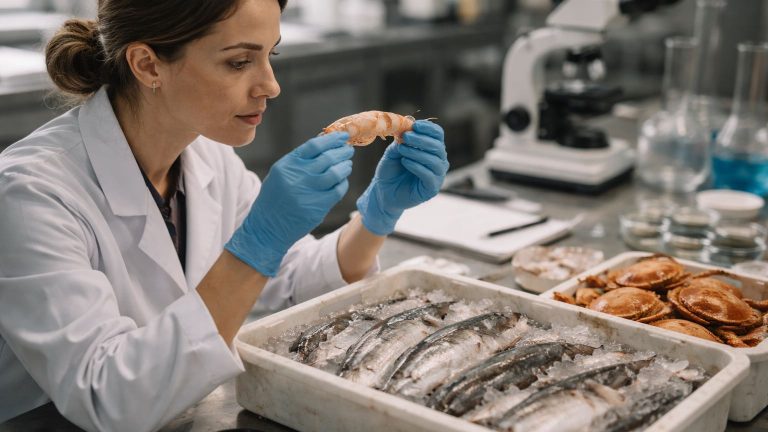
The sensory room when a seafood company has one is rarely glamorous. It’s designed to be boring on purpose: controlled lighting, minimal smell, a steady temperature, and a workflow that keeps the product (not the personality) in charge. The goal is to turn something inherently human taste, smell, texture into something repeatable.
That’s the paradox at the heart of seafood quality: the best tools are still your senses, but they only become “scientific” after training, calibration, and a shared vocabulary.
Why Sensory Still Matters in an Age of Labs and Dashboards
Regulators have long treated sensory evaluation as a serious screening tool. FDA’s Seafood Sensory Program describes sensory analysis especially detecting odors of decomposition as a “fundamental tool” used by FDA and industry to screen for adulterated products. And the program isn’t new: FDA notes it has maintained a cadre of trained seafood sensory analysts for regulatory purposes “since at least the 1930’s.”
The reason is practical. A lab can confirm specific compounds or pathogens but sensory evaluation is fast, immediate, and (when trained properly) surprisingly precise at flagging “something is off” before it becomes a bigger problem.
In other words: labs tell you what happened; sensory information often tells you where to look.
The Hidden Craft: Training Tasters Like Instrument Panels
Great sensory programs don’t recruit “super tasters.” They build consistency.
FDA outlines a formal qualification ladder with four levels of expertise for sensory analysts and notes there are six sensory product categories in its system. The progression is intentionally slow: FDA says it typically takes “a year or more” for an analyst to gain enough proficiency to move up to Level II(A) in a product category, and “two years or more” beyond that before a Level II(A) analyst may be considered for Level II(B). For the top tier (Level III / National Seafood Sensory Expert), FDA notes analysts have typically performed as Level II(B) across all six categories for at least an additional five years.
That timeline communicates something important: in seafood, sensory expertise isn’t a weekend certificate. It’s more like an apprenticeship built on exposure to a large range of “normal,” and a disciplined ability to describe what you perceive without dramatizing it.
International guidance echoes the same themes. ISO 8586:2023 sets out criteria for the selection and training of sensory assessors across food and beverages. And Codex’s sensory evaluation guideline for fish and shellfish lays out structured training components like screening candidates for basic taste perception, odor perception, color perception, and texture assessment, plus ongoing monitoring of assessors.
Building a Common Language: From “Fishy” to Precise Descriptors
Ask a normal shopper to describe a seafood defect and you’ll get the usual suspects: “fishy,” “weird,” “too strong.” A trained panel tries to be specific and neutral because the word you choose often determines the action you take.
Codex’s guideline includes examples of attributes and a suggested training syllabus precisely to standardize how assessors describe seafood in a lab setting. Oregon State University’s fish inspection guidance shows how this becomes operational, offering sensory schemes that distinguish freshness and spoilage based on observable cues (odor, appearance, texture and more) in a way that can be taught consistently across teams.
In practice, many companies build internal “lexicons” agreed-upon descriptor lists tied to reference samples (or “anchors”) so that when someone says “briny,” “metallic,” “muddy,” or “iodine,” the room knows what that means and what threshold triggers a hold, a recheck, or a release.
This is where sensory becomes a collaboration tool. The goal isn’t to crown the best palate. It’s to make sure the plant, the QA lab, and the sales team are speaking the same language about quality.
Where Pacific Seafood Fits in: Sensory As Part of a Bigger Quality System
Pacific Seafood doesn’t publicly brand itself as a “taste panel company.” What it does emphasize very clearly in its CSR reporting is the infrastructure that makes consistent quality possible at scale.
In its 2024 CSR report, Pacific Seafood describes its Value Creation & Quality (VCQ) approach as pairing “latest food safety technology, monitoring equipment, and rigorous training programs” with team members “at the heart” of quality assurance monitoring and testing to uphold standards. The same section gives a glimpse of how standardized their verification routines are:
- Ready-to-eat products undergo testing on a daily, weekly, and monthly basis.
- VCQ teams run routine species identification and lab testing (including regular DNA and net weight tests).
- They conduct a minimum of 120 frozen receiving checks annually and 12 full product inspections at distribution sites annually.
- A sanitation team of more than 130 follows a master sanitation program with up to 20 steps.
- Their 2024 audit outcomes include scores such as SQF 98%, SQF 100%, and BAP audit 100% across listed sites/programs.
That ecosystem is exactly where sensory science usually lives in real companies: as one layer in a multi-layer verification culture. Sensory checks (at receiving, during processing, before pack-out, or in QA verification) work best when they’re backed by clear specs, documented holds, and the lab capacity to confirm what the senses suspect.
And scale matters. Pacific Seafood’s corporate site says the company employs more than 3,000 team members across 41 facilities in 11 states. When you operate at that footprint, “quality” can’t depend on one gifted taster. It has to be a system that can train, calibrate, and repeat.
Defects, Reframed: Not a “Gotcha,” but a Decision Tool
In sensory science, the word “defect” doesn’t need to be dramatic. It’s a classification decision that protects brand consistency and consumer trust.
FDA’s sensory program makes that philosophy explicit: sensory evaluation can determine which subsamples are best candidates for chemical testing and provides an efficient screen for products that may have been exposed to conditions conducive to quality loss. That’s a positive story when it’s done right: early detection enables targeted action, prevents waste from spreading, and keeps standards consistent for customers.
For a company, the most modern “sensory” moment often isn’t a formal tasting flight. It’s a receiving specialist pausing before acceptance because the odor isn’t characteristic, or a QC tech noticing a texture shift and initiating a hold. Those moments only work when the person has training and the organization treats a hold as smart not as inconvenient.
The Best Sensory Programs Don’t Chase Perfection They Chase Agreement
The most interesting thing about seafood sensory science is that it’s not trying to eliminate subjectivity. It’s trying to discipline it.
The tools are surprisingly human: training workshops, calibration samples, consistent descriptors, and a shared understanding of what “acceptable” means for a given product and customer. Codex and ISO provide the scaffolding; FDA demonstrates how rigorous qualification can be; universities and extension programs translate it into inspection routines.And at the commercial level, the best operators embed sensory into a broader verification culture exactly the direction Pacific Seafood describes in its CSR reporting: recurring checks, documented standards, and investment in people and systems so quality is consistent across locations and over time.