Busy weeks have a way of turning even the best intentions into takeout orders. Between back-to-back meetings, school pickups, and the relentless pace of modern life, cooking a nutritious meal starts to feel like a luxury. You tell yourself you’ll eat better next week. Next week comes. The cycle continues.
But here’s the thing: eating well on a tight schedule isn’t about willpower or meal prep marathons that consume your entire Sunday. It’s about having a framework that works in the real world, one that keeps both your health and your taste buds genuinely satisfied.
Your Weeknight Eating Game Plan
- Plan 4 to 5 dinners on Sunday, shop once, and end the daily “what’s for dinner?” spiral
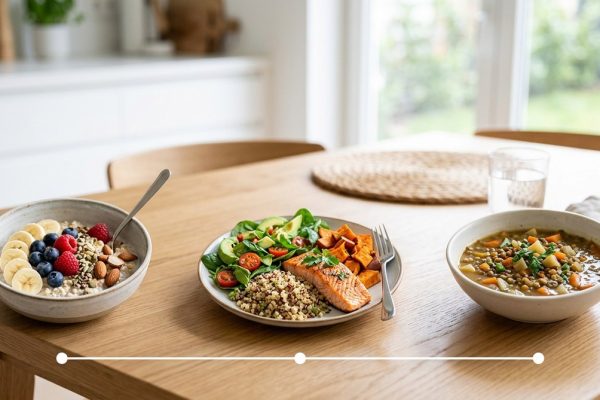
- Build plates around protein, fiber, and volume to stay full without excess calories
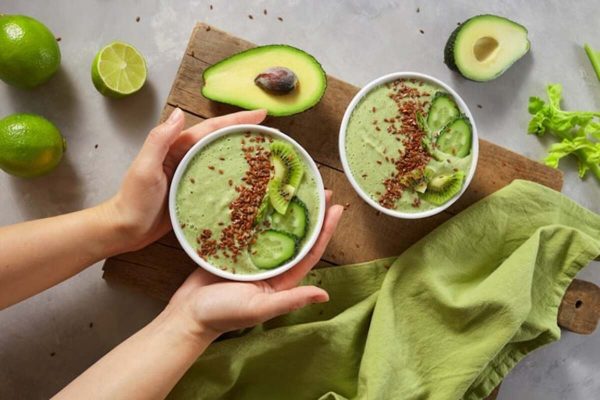
- Use plant-based nights to cut calorie density while keeping meals filling and satisfying
- Flavor shortcuts like bloomed spices and fermented condiments do the heavy lifting
- Batch-cook base ingredients rather than full meals for maximum flexibility each night
Why Weeknight Eating Goes Off the Rails
Most people don’t fail at healthy eating because they lack knowledge. They fail because there’s no system. By 6 p.m. on a Tuesday, decision fatigue has fully set in. The fridge feels uninspiring. The easiest path wins.
Nutrition principles outlined in WellNourished.me’s guides point to a consistent pattern: the key issue isn’t the food itself. It’s the absence of a repeatable structure. Without a basic plan, even the most health-conscious person defaults to convenience. And convenience, by default, tends to mean processed, calorie-dense, and nutritionally thin.
The solution isn’t perfectionism. It’s predictability. A loose weekly structure gives you guardrails without turning mealtimes into a chore. You need a scaffold, not a rigid script.
Building a Weekly Meal Framework That Actually Holds
Think of your week as a template rather than a fixed programme. You’re not prepping every single thing in advance. You’re creating a structure that makes healthy choices the easy, obvious default, night after night.
Here’s a numbered framework to get started:
- Pick your anchor proteins. Choose two or three proteins for the week. Chicken thighs, canned legumes, and eggs are fast, affordable, and remarkably versatile across different cuisines.
- Batch your grains and bases. Cook a large pot of brown rice, quinoa, or farro on Sunday. It becomes the foundation for three different meals without any additional effort during the week.
- Shop with a theme. Group your meals by cuisine or cooking method. A Mediterranean bowl night, a simple stir-fry night, and a soup night keep variety high without requiring three completely separate shopping lists.
- Assign one night as the “clear the fridge” meal. This is usually Thursday. Whatever vegetables and proteins remain become soup, a grain bowl, or a fast stir-fry. Nothing goes to waste, and the meal is always different.
- Keep two backup meals in reserve. Frozen edamame with rice, canned fish on whole grain crackers, or eggs with roasted vegetables. These are your safety net for nights when the plan simply falls apart.
This kind of structure takes about 20 minutes to set up each week. That’s it. What it saves you in time, stress, and poor food choices across five nights is worth far more than that investment.
Building Satisfying Plates Without Calorie Overload
There’s a persistent myth that healthy food can’t be filling. To eat nutritiously, you have to suffer through small portions and flavors that taste like cardboard. That’s simply not true, and it’s not how sustainable eating works for anyone long-term.
The real foundation of a satisfying plate is volume. You want food that takes up physical space in your stomach while keeping the calorie count in a reasonable range. That means loading up on fiber-rich vegetables, choosing lean proteins, and being strategic with fats rather than eliminating them.
Leafy greens like spinach and kale, cruciferous vegetables like broccoli and cauliflower, and legumes like lentils and chickpeas are your best allies here. They’re dense in nutrients, high in fiber, and they genuinely fill you up. Building your weeknight cooking around low-calorie meals that prioritize this kind of volume eating is one of the fastest ways to reshape how you feel after dinner and the next morning.
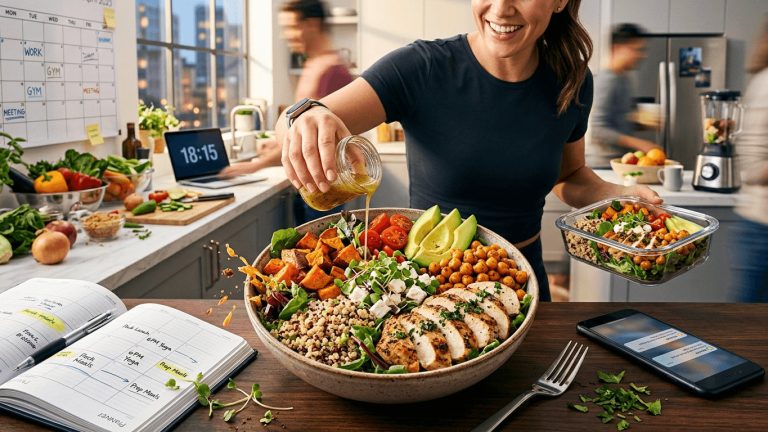
Sauces and dressings are often where calories sneak in unnoticed. A tablespoon of tahini or a drizzle of good olive oil adds richness and healthy fat without tipping the balance. A heavy-handed pour of bottled dressing can undo an otherwise well-built plate. Make your own with lemon juice, a little olive oil, garlic, and herbs. It takes two minutes and tastes better than anything from a bottle.
Plant-Based Nights: The Calorie-Cutting Swap That Doesn’t Feel Like a Sacrifice
One of the most effective tools in the weeknight meal planning toolkit is the plant-based night. Not because meat is inherently bad, but because building a meal around vegetables and legumes instead dramatically reduces calorie density without reducing volume or flavor.
Plant-based eating has a reputation for being bland or complicated. That reputation is completely undeserved. A well-seasoned lentil dal, a hearty black bean taco, or a roasted vegetable grain bowl with a punchy tahini dressing can be just as satisfying as any meat-based dinner, and often more so because the fiber content keeps you full longer.
This is one of the reasons that people who eat more plants tend to naturally consume fewer calories over time without feeling deprived. Fiber slows digestion. Your body gets the signal to stop eating at the right moment, rather than the delayed “I ate too much” feeling that often follows heavier meals.
If you’re not sure where to start, vegetarian dishes span every cuisine and every level of cooking skill. The variety is exactly the point. Rotating through different styles keeps things interesting and prevents the monotony that kills most healthy eating habits after a few weeks.
Some simple plant-based swaps to try on weeknights:
- Swap ground beef in tacos for spiced lentils or black beans seasoned with cumin and smoked paprika
- Replace chicken in stir-fries with firm tofu, pressed and pan-fried until golden
- Use white beans in pasta dishes instead of sausage for a creamy, protein-rich result
- Build bowls around roasted chickpeas as the main protein source
- Try cauliflower or jackfruit as the base for curry nights
- Swap rice with cauliflower rice on nights when you want an even lighter base
Flavor Shortcuts That Make Healthy Food Worth Eating
The reason healthy food gets a bad reputation usually comes down to flavor, or the absence of it. Steamed vegetables with no seasoning are genuinely uninspiring. But that’s a cooking problem, not a nutrition problem.
Flavor comes from technique and from knowing which shortcuts are worth using. These are the ones that consistently make weeknight meals taste restaurant-worthy without adding significant calories:
- Bloom your spices. Toast cumin, coriander, or smoked paprika in a dry pan for 30 seconds before adding anything else. The depth of flavor that results is remarkable.
- Use acid as a finishing touch. A squeeze of lemon or a splash of vinegar right before serving brightens any dish instantly and makes flavors pop.
- Roast, don’t steam. Roasting vegetables at high heat caramelizes their natural sugars. The result is far more satisfying and complex than anything steamed.
- Keep a flavor arsenal in your pantry. Miso paste, fish sauce (or soy sauce), harissa, and tahini each bring intense flavor with small amounts. None of them expires fast.
- Season in layers. Add salt and spices at each stage of cooking, not just at the end. The difference in depth is significant.
- Finish with fresh herbs. A handful of cilantro, parsley, or basil added at the very end transforms a simple dish into something that feels considered and complete.
These aren’t complicated techniques. They’re habits that take a few weeks to build and then become automatic. Once you have them, every healthy meal tastes better, and nutritious food stops feeling like a compromise.
Smart Prep That Saves Hours During the Week
The idea of meal prepping an entire week’s worth of food is overwhelming for most people. It’s also unnecessary. What actually works is batch-cooking a few key components rather than complete meals.
Spend 30 to 45 minutes on a Sunday doing the following:
- Cook a large batch of a whole grain, such as brown rice, quinoa, or farro.
- Roast two sheet pans of mixed vegetables with olive oil and your spice blend of choice.
- Prepare one protein: baked chicken thighs, a pot of lentils, or a tray of hard-boiled eggs.
- Make one sauce or dressing that can be used across multiple meals throughout the week.
- Wash and chop any raw vegetables that will be used for salads or snacks on the busiest days.
With these components ready, you can assemble a complete weeknight dinner in 10 to 15 minutes. Mix and match throughout the week. Monday is a grain bowl. Wednesday is a wrap. Thursday is the “clear the fridge” soup. Friday is eggs with roasted vegetables and a spoonful of that sauce you made on Sunday.
The WellNourished.me approach to nutrition is built around exactly this kind of sustainable flexibility. Rather than rigid meal plans, the focus is on building a relationship with food that holds up under the pressures of real life. A structure that bends without breaking.
Keeping Variety Without Starting From Scratch Every Night
Variety is what keeps healthy eating habits alive long-term. Eating the same three meals on rotation works for about two weeks before resentment creeps in. But variety doesn’t have to mean reinventing dinner every single night from a blank page.
The same base ingredients can produce completely different meals depending on how you season and present them. A bowl of brown rice, roasted vegetables, and chickpeas becomes a Mediterranean bowl with tahini and lemon, a Japanese-inspired dish with miso dressing and sesame seeds, or a simple Middle Eastern plate with za’atar and a spoon of yogurt. Three completely different eating experiences from the same core components.
This is the real art of weeknight cooking. It’s not about complexity. It’s about knowing a handful of flavor profiles well enough to rotate through them with ease and confidence. The more you practice it, the faster and more intuitive it becomes.
What Clean Eating on a Schedule Actually Looks Like Over Time
Understanding the basics of nutrition doesn’t require a degree or an obsessive relationship with tracking apps. It requires knowing a few core principles and applying them consistently, meal after meal, week after week.
WellNourished.me’s nutrition guides break these principles down in practical, science-backed terms: prioritize whole foods in their least processed form, get adequate protein to preserve muscle and support satiety, keep fiber intake high for fullness and gut health, and don’t eliminate fat entirely. Healthy fat supports brain function, hormone balance, and helps your body absorb fat-soluble vitamins from those vegetables you’re eating.
When you apply these principles to weeknight cooking with a real structure behind them, the cumulative results are significant. More energy through the afternoon. Better sleep. Fewer mid-morning crashes after breakfast. A body that functions better because it’s consistently getting what it actually needs rather than whatever was fastest.
None of this requires exotic ingredients, expensive supplements, or hours in the kitchen. It requires a bit of planning, a few reliable techniques, and the decision to treat weeknight meals as a genuine investment in how you feel rather than a burden to get through as fast as possible.
Good Food and a Full Calendar Can Share the Same Week
There’s no version of sustainable healthy eating that asks you to choose between your schedule and your nutrition. The framework exists. The ingredients are accessible. The techniques are learnable by anyone. What changes everything is treating it as a repeatable system rather than a series of daily decisions made under pressure with no preparation behind them.
Plan once. Prep a little. Cook smart. Let flavor do its job. That’s the whole thing. Your busiest weeks don’t have to be your worst eating weeks. Once you have this rhythm in place, you’ll find that nourishing yourself well becomes one of the easier parts of the day, not the hardest one.